

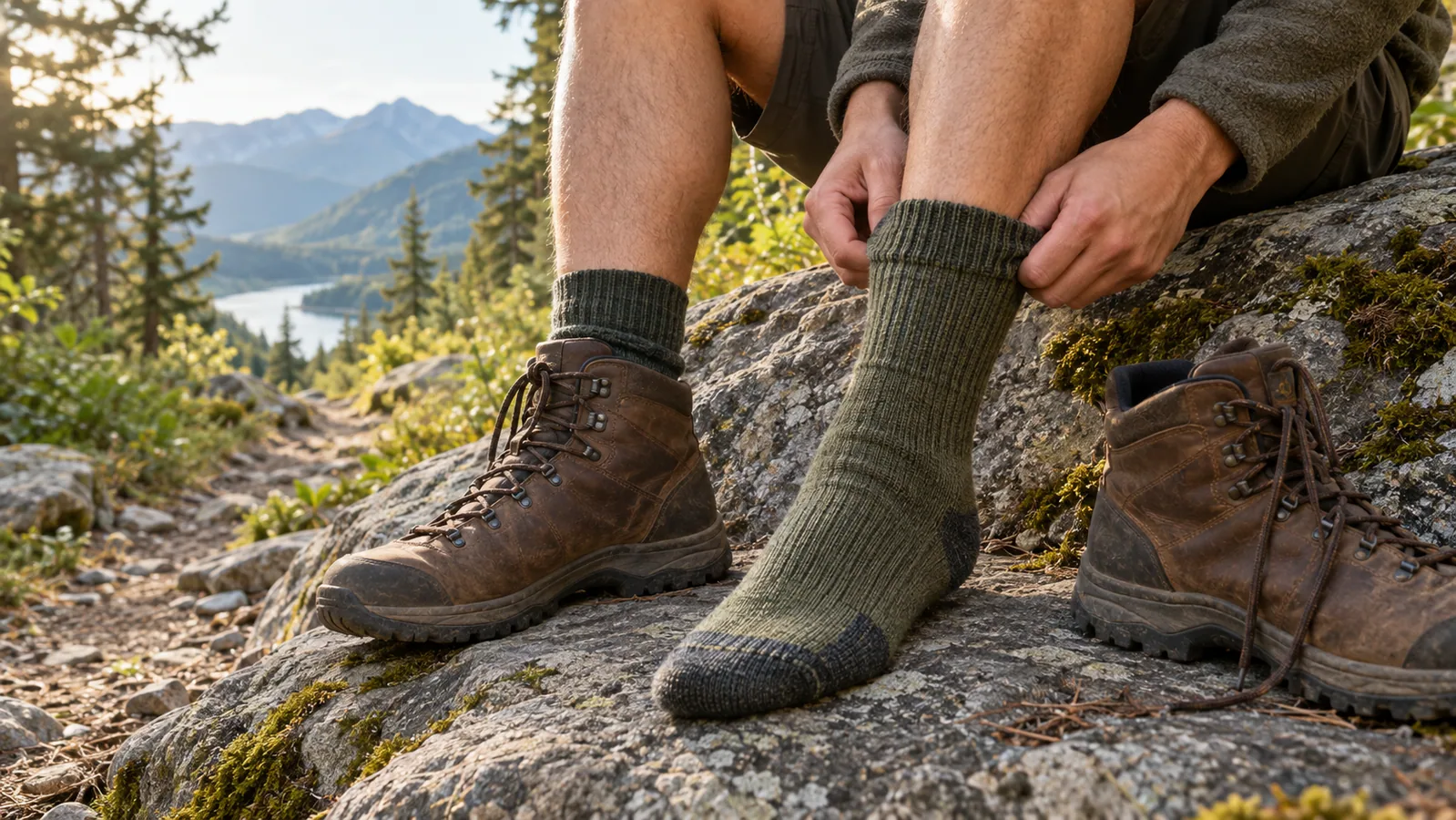
A good hiking sock should disappear from your thoughts once you start walking. If you keep tugging at the heel or thinking about a seam, something is wrong. The best hiking socks fit your feet and your shoes at the same time. A famous label cannot do that job for you.
I would start with a cushioned merino wool blend for most day hikes. Darn Tough's Hiker Micro Crew is my first pick. It has useful padding, a close fit, and a strong warranty. For warmer weather or snug hiking shoes, I would try the lighter Darn Tough Light Hiker first.
There are good reasons to choose something else. Some feet feel better in a softer full cushion sock. Others do not get on with wool at all. Toe socks may help where toes rub together, but their fit takes more care. These seven picks cover those different needs.
The best hiking socks at a glance
| Hiking socks | Best use |
|---|---|
| Darn Tough Hiker Micro Crew | My starting point for most hikes |
| Darn Tough Light Hiker Micro Crew | Lighter feel in warm weather |
| Smartwool Hike Full Cushion Crew | More padding around the whole foot |
| Darn Tough Coolmax Hiker Micro Crew | A synthetic alternative to merino wool |
| Farm to Feet Damascus Crew | Light fabric with targeted cushioning |
| Injinji Trail Midweight Crew | Separate sleeves for each toe |
| Danish Endurance Classic Hiking Crew | A lower price per pair in a multipack |
Prices below are the listed US prices for the linked styles. Multipacks, colors, and sizes can change the total. I would buy one suitable pair before filling a drawer with the same sock.
1. Darn Tough Hiker Micro Crew: my best hiking socks for most trips

A useful middle ground
The Darn Tough Hiker Micro Crew Midweight is a sound place to start. The 1466 style blends 61% merino wool with nylon and a little stretch fiber. It has cushioning underfoot and a close knit that suits a secure fit.
At $26 a pair, these Darn Tough hiking socks cost more than basic cotton socks. I would pay that for a pair that fits well and gets used often. I would not buy them just because other hikers speak warmly of the brand.
Midweight does not mean padded everywhere
The Hiker's cushion sits where the foot needs contact padding. That differs from a full cushion sock with padding around the whole foot. I like that middle ground for cool day hikes and boots with enough spare room.
It also helps explain why sock labels can be confusing. Fabric weight and cushion coverage are separate details. Check both when comparing Darn Tough socks with another brand.
Try the micro crew height with your boots
The cuff sits above low hiking shoes and many standard hiking boots. With a tall boot, check where its top lands. I want sock fabric between skin and the boot collar all the way around.
A snug fit should hold the heel pocket in place without squeezing the toes. If the shoe already feels tight, more sock will not improve it. The Darn Tough Light Hiker may be a better fit in that case.
What gives me pause
For hot weather, this is more sock than some people need. The midweight knit may feel warm during a hard climb. I would choose a lighter sock for a fast summer walk in close-fitting trail runners.
Darn Tough's lifetime guarantee adds value, but it does not mean the fabric cannot wear out. Good shoe fit, trimmed nails, and sensible washing still matter.
My first choice for regular hikes when the shoe has room for a midweight sock.
Reasons to buy: Cushioned sole; Lifetime guarantee.
Keep in mind: More warmth and bulk than the Light Hiker.
2. Darn Tough Light Hiker Micro Crew: best for a lighter feel

Less bulk, with padding in useful places
The Darn Tough Light Hiker Micro Crew is my first choice for warm weather hiking. The current 1972 style has mesh over the foot and cushioning underfoot, around the ankle, and up the Achilles.
That gives it a lighter body without stripping away every soft spot. I would use this shape in hiking shoes or trail runners with less spare volume than a roomy boot.
The wool percentage tells only part of the story
This Darn Tough Light Hiker blend is 43% merino wool, 54% nylon, and 3% stretch fiber. It has less merino wool than the Hiker 1466. I do not see that as a lower score. The blend serves a different cut and weight.
Nylon adds strength to the knit, while merino wool helps with comfort and odor control. I would judge the result on fit and use. A higher wool number does not always make a better hiking sock.
Where I would choose it
Summer hiking, brisk day hikes, and a light pack are strong uses for the Light Hiker Micro Crew. The listed price is $25. For someone who walks in running shoes as often as boots, it is a flexible starting point.
Compare it with other lightweight hiking socks using the same footwear. A sock that feels thin in the hand may feel quite padded once the laces are tied.
Where I would want more
For a cold, slow walk with long stops, I would consider more warmth. A lightweight sock cannot make a thin shoe into winter footwear. Nor would I expect the Darn Tough Light Hiker to soften every rough step under a heavy pack.
Buy the Light Hiker for its balance of a light body and useful cushion. If you want plush padding all around the foot, the Smartwool pick below makes more sense.
I would start here for warmer walks in low hiking shoes or trail runners.
Reasons to buy: Light body with useful cushion; Mesh over the foot.
Keep in mind: Less warmth for cold, slow walks.
3. Smartwool Hike Full Cushion Crew: best for fuller padding

Full cushion means more coverage
The Smartwool Hike Full Cushion Crew adds cushioning across the whole sock. Smartwool calls it medium thickness. That is useful context: full cushion describes where the padding sits, not the thickest sock the brand makes.
I would choose these Smartwool hiking socks for boots that leave enough room around the foot. They are a stronger choice for a cool walk than for a tight shoe on a hot afternoon.
Softness needs space to work
Extra padding can feel lovely when there is room for it. Jam it into a small shoe and the result can be pressure instead. Try the socks with your actual boots, not just on a bare floor.
The merino wool blend has reinforced wear zones, mesh areas, and a low-profile toe seam. A shaped fit and cuff help hold the sock in place. The listed price is $27.
A good choice for cool days
I like full cushion for a slower pace, cool weather, or someone who prefers a softer feel. These Smartwool hiking socks also have a crew height, which gives more lower-leg coverage than a short ankle sock.
I would still keep winter hiking in context. Socks are one part of keeping feet warm. Footwear, dampness, pace, and time spent standing still can matter just as much.
The trade-off is volume
Full cushion takes up space and can feel warm. If your toes lose room or the heel starts to lift, try a different thickness or cut. More padding is useful only when it works with the shoe.
I would choose the Darn Tough Light Hiker over this pair for a snug low shoe in warmer weather. I would choose Smartwool when fuller padding feels right in a roomy boot.
I would choose this pair for fuller padding in boots that have enough room.
Reasons to buy: Cushion around the whole foot; Crew coverage.
Keep in mind: Takes more space inside a close-fitting shoe.
4. Darn Tough Coolmax Hiker Micro Crew: best synthetic choice

A familiar shape without a merino blend
The Darn Tough Coolmax Hiker Micro Crew offers the brand's hiking shape with synthetic fibers. The 1931 style uses nylon, Coolmax polyester, acrylic, stretch fiber, and a small amount of other fiber.
I would look here if merino wool socks feel itchy or simply do not suit you. You do not have to wear wool to buy proper hiking socks. Fit and moisture control still matter more than joining a fabric camp.
It is still a midweight sock
Coolmax does not mean the sock is paper-thin. This pair has a midweight knit and cushion beneath the foot, with padding around the ankle and Achilles. I would check its bulk as carefully as I would with wool socks.
The $25 price is close to the Darn Tough Light Hiker. I would choose between them based on fabric feel and footwear space, rather than expect a large saving from synthetic socks.
A useful choice for sweaty feet
A moisture-wicking blend can move sweat away from the skin. The shoe still has to let moisture leave. In a hot, sealed boot, any sock can become damp.
For sweaty feet, I would carry a dry spare and take a proper break to change if needed. That small habit can make more difference than switching from one good sock blend to another.
What I would watch
Do not expect the same odor behavior as merino wool. Wash the socks when needed, and let them dry fully before storing them. A day of airing does not remove dirt.
The Coolmax Hiker Micro Crew is my synthetic alternative for someone who likes Darn Tough's cut. For a much different fit around the toes, consider the Injinji pair.
I would choose this for Darn Tough fit without a merino wool blend.
Reasons to buy: Moisture-wicking synthetic blend; Cushioned sole.
Keep in mind: Still a midweight sock, despite the cooling name.
5. Farm to Feet Damascus: best light sock with targeted cushioning

Padding where it earns its place
The Farm to Feet Damascus Light Targeted Cushion Crew pairs a light body with dense padding in selected areas. I like that idea for walkers who want some softness without full cushion around the entire foot.
The linked crew version uses 51% US merino wool, 46% US nylon, and 3% stretch fiber. Its flat toe closure reduces seam bulk. The current product price is $26.
A different cut is worth trying
If Darn Tough socks do not fit your feet well, I would try the Farm to Feet Damascus before giving up on merino wool hiking socks. Two brands can use similar fibers and still feel quite different around the arch and heel.
That is why I would avoid buying six pairs on someone else's say-so. One short walk in the right shoes can tell you whether the heel sits where it should.
Check the exact height
Farm to Feet sells Damascus socks in several heights. This pick is the crew. Other versions can have different fiber blends, so compare the exact product rather than borrow the details from a bundle.
The crew cuff sits on the lower calf. I would choose it when I want more coverage above a boot while keeping the body of the sock fairly light.
Care and value
Farm to Feet calls for cold washing and line drying or a tumble cycle with no heat. The brand also has a satisfaction guarantee. Read the return steps and keep the socks clean if you need to send them back.
I see the Farm to Feet Damascus as a strong fit alternative, with US fibers and construction as an added reason to choose it. That does not establish that it will last longer than every other sock here.
I would try this light crew when a different heel and arch fit could help.
Reasons to buy: Light body with targeted padding; US fibers and construction.
Keep in mind: Price is close to other premium single pairs.
6. Injinji Trail Midweight Crew: best for separate toe sleeves

Each toe gets its own space
The Injinji Trail Midweight Crew wraps each toe in its own sleeve. That removes direct skin contact between neighboring toes. I would consider toe socks when that contact is a recurring source of rubbing.
The footbed has cushion, while the top uses mesh. The current blend is 58% nylon, 39% Coolmax EcoMade polyester, and 3% stretch fiber. Prices start at $18.
Fit is more detailed with toe socks
Five sleeves create five more places to check. Each toe should reach comfortably without fabric pulling hard into the gaps. Take time to settle the socks before putting shoes on.
I would try a short walk with hills before a long trip. Downhill steps can reveal sliding or pulling that is hard to notice while standing in the house.
Padding without a second sock
This is a cushioned sock to wear on its own. It is not the same as a thin liner. Adding another thick sock can leave too little room in the shoe.
For trail running or hiking in low shoes, I like the crew coverage and padded sole. The toe sleeves are the main reason to choose it, though. If they bother you, a conventional sock is a better buy.
No sock can promise no blisters
Toe socks can address one source of rubbing. They cannot fix a poor shoe fit, and they do not suit every foot. I would stop and adjust at the first sign of discomfort rather than hope the fabric will settle later.
Keep the first purchase small. A toe sock that fits well can be useful. A drawer full of the wrong toe shape is just an expensive lesson.
I would consider it for toe-to-toe rubbing, after a short fit test with hills.
Reasons to buy: Fabric separates neighboring toes; Cushioned sole and mesh top.
Keep in mind: Toe sleeve fit needs close attention.
7. Danish Endurance Classic Hiking Crew: best multipack value

Compare the price per pair
The Danish Endurance Classic Hiking Crew Socks are sold in several pack sizes. The US three-pack is listed at $50. That works out to about $16.67 per pair before tax and delivery.
That is a useful saving beside the single-pair prices above. I would still check the delivered total. A pack is a good deal only when all three pairs fit and get worn.
A blend with less wool
These Danish Endurance socks use 38% merino wool, 30% acrylic, 30% nylon, and 2% stretch fiber. They have cushioned heels and toes, plus vent zones. They are merino wool blend socks, not pure wool socks.
I would choose them for a lower-cost rotation for day hikes. I would not assume they feel the same as Darn Tough socks because both labels mention merino wool.
Read the size selector closely
The product selector uses EU sizes, with a chart for US shoe sizes. Match the range carefully. A familiar letter size from another brand may not apply.
Try the first pair inside with your hiking shoes. Look for loose fabric under the arch and room around the toes. Those details matter more than the color mix in the pack.
The care rules differ
The brand asks for a wash no warmer than 30°C and no tumble drying. It offers a one-year hole guarantee. That is a different promise from Darn Tough's lifetime terms.
I like the lower unit price, but I would choose a single premium pair first if fit is hard to get right. Once you know what works, a multipack is easier to justify.
I would buy the three-pack once I knew the cut worked for my feet.
Reasons to buy: Lower listed price per pair; Several color and pack choices.
Keep in mind: No tumble drying.
Merino wool or synthetic hiking socks?
Why merino wool is a common starting point
Merino wool socks offer a soft feel and useful odor control. They can work in warm or cool weather, depending on the knit and thickness. I would not judge them by the heavy wool socks you might remember from a cold house.
Most hiking socks blend merino wool with synthetic fibers. The added fibers help the sock hold its shape and cope with wear. Stretch fiber helps keep the heel and cuff in place.
Why I would not chase the highest wool number
Look at the two merino Darn Tough picks. The Hiker has more wool, while the Light Hiker has more nylon. That alone cannot tell you which will feel better on a hot walk.
A lighter body, mesh zones, and a close fit can matter as much as fiber content. The best hiking socks make those details work together. They are not a contest to print the largest wool percentage.
When synthetics make sense
Synthetic socks are worth trying if wool irritates your skin or you prefer their feel. They are also a sensible choice for repeated washes and a damp trip where drying matters.
I would compare the whole sock rather than call one fiber the winner. A thick synthetic sock may dry more slowly than a very thin wool blend. Weight, air flow, and weather all affect the result.
Why cotton is a weak default for long wet walks
Cotton holds moisture and can stay damp against the skin. That is a drawback when you need the same footwear for hours. I would leave thick everyday cotton socks out of a wet hiking plan.
For a short, dry stroll, comfort still matters. But when buying new hiking socks for longer routes, I would begin with a purpose-made wool blend or a moisture-wicking synthetic pair.
Lightweight cushioning or full cushion?
Match the padding to the space in your shoes
Lightweight hiking socks suit close-fitting shoes and warmer weather. Full cushion gives more padding around the foot, but needs room. Neither is the best hiking sock for every trip.
I would try the sock with the shoe laced as I plan to wear it. Walk up and down a slope if the shop has one. Check for heel lift and pressure across the toes.
Medium cushioning is often enough
You do not need maximum thickness for every rocky path. The sole and insole of your hiking shoes already do part of the work. A sock adds a softer layer and helps manage contact with the skin.
Medium cushioning can be a useful middle ground. If a thicker sock makes the shoe tight, a thinner sock may feel better even though it has less padding.
Full cushion is not a cure for a poor shoe
If the shoe bends in the wrong place or squeezes your toes, adding full cushion can make it worse. I would deal with the footwear fit first.
The best hiking boots should work with the socks you plan to wear. Take those socks when shopping for boots. Trying footwear with a thin store sock can hide a space problem.
How hiking socks fit with hiking shoes
Start with the heel pocket
The shaped heel should sit on your heel, not under the arch or halfway up the ankle. Smooth the sock before tightening the laces. There should be no folds under the foot.
A well fitting sock feels close without pulling the toes back. If you need to stretch it hard just to seat the heel, check the size chart again.
Leave the toes room to move
Your toes should not be curled or squeezed together by the sock. Check this before blaming the shoe. Then check the same thing with the shoe on.
For toe socks, look at each sleeve. Extra fabric at a toe tip can fold; a short sleeve can pull. The right overall shoe size does not promise the right toe length.
Keep the cuff above the collar
Sock height should follow the footwear. A no show sock may suit a low running shoe, but it leaves skin exposed above many hiking boots. A crew gives more cover from the collar and loose trail grit.
I would choose height for contact and coverage first. A low sock that looks tidy is less useful if you spend the whole walk feeling a boot edge against bare skin.
Brand loyalty comes after fit
In a discussion of hiking sock fit, one walker preferred Smartwool's fit and cushion, while another favored Darn Tough. That is a useful split. Even hikers who agree on merino wool can prefer different cuts.
I would use those reports as a reason to compare, not as a vote that settles the choice. Your foot does not need to match the most popular answer.
The best hiking socks for warm weather
Start with less bulk
For warm weather hiking, I would try the Darn Tough Light Hiker before the midweight Hiker. The lighter body leaves more space and uses mesh over the foot. That makes it a sensible first pair for low hiking shoes.
A breathable hiking sock still depends on the shoe around it. If the shoe traps heat and moisture, the sock has limited room to help. Think about the two as a pair.
Take a dry spare
Sweaty feet can soak even good lightweight hiking socks. A spare pair lets you change when the first pair is damp or gritty. Air your feet during the break and check for folds or sore spots.
I would rather carry one dry pair than insist a single fabric can keep feet cool all day. Warm weather, pace, and terrain can change faster than a product label can account for.
Keep trail debris out
Small stones and grit can turn a comfortable sock into a rough one. Shake out your shoes when something feels wrong. Check inside the sock too.
A higher cuff gives more cover, though it is no guarantee against dust. For summer hiking, I would balance that cover with the heat and the type of trail.
Wool socks for cold weather hiking
Warmth needs enough room
For cold weather, full cushion can be useful when the boots have space for it. I would consider the Smartwool pair for that job. For a steady pace in milder cold, the Darn Tough Hiker may be enough.
Do not squeeze thick wool socks into boots that already fit tightly. Keeping feet warm depends on more than piling on fabric. Comfort and room to move still count.
Winter hiking asks more of the whole setup
Winter hikes may involve snow, long stops, and much colder ground. None of these general hiking socks makes a summer shoe suitable for every winter route. Match the footwear and clothing to the conditions.
Mountaineering socks are a separate category with different uses. I would not choose them for a normal trail walk just because they sound more protective. Too much bulk can be its own problem.
Dry socks are part of the plan
Wet weather can soak a good pair from above the boot. Tuck clothing and adjust layers with that in mind. Our rain pants guide explains why cuffs and fit matter as much as the shell fabric.
For cold weather hiking, keep the spare pair in a dry bag. A damp spare offers much less comfort at the end of a long day.
How many socks for backpacking trips?
A walking pair and a dry spare
For a short backpacking trip, I would begin with a pair to wear and a spare to keep dry. Longer routes may call for another pair, depending on washing chances and the forecast.
Do not choose the count by a fixed miles-per-pair rule. Some walks are dusty, some are soaked, and some let you wash and dry gear each evening.
Keep sleep socks out of wet boots
A dry pair in the sleeping bag is a small comfort worth protecting. I would keep it away from wet footwear on the walk to fetch water or visit the bathroom.
If you sleep off the ground, the same habit applies. Our camping hammock guide covers the shelter and insulation choices around that dry sleep setup.
Rotate without pretending dirt is harmless
Air the worn pair when you stop, but do not confuse a lack of odor with clean fabric. Grit and dried sweat can remain in merino wool socks even when they smell fine.
For long backpacking trips, plan a proper wash when possible. Carrying fewer pairs works only if you can keep the ones you have fit to wear.
Can hiking socks prevent blisters?
They can help, but fit still matters
No sock can promise that you will never get a blister. Moisture, rubbing, shoe fit, and time on your feet all play a part. The best hiking socks reduce avoidable problems; they do not remove every risk.
The American Academy of Dermatology's advice on preventing blisters calls for moisture-wicking socks and shoes that fit. It also says to stop when you notice pain, discomfort, or red skin.
Act on hot spots early
A hot spot is a reason to stop and check, not a challenge to push through. Look for a fold, grit, a damp sock, or a place where the shoe rubs. Deal with the cause before carrying on.
I would keep a dry spare close enough to reach without emptying the pack. A useful item buried at the bottom is easy to put off using.
Toe socks address one kind of contact
Toe socks put fabric between toes that might otherwise rub together. That can be useful for toe blisters. They still need a good fit in the toe sleeves and the shoe.
If the sleeves pull into the gaps or bunch at the tips, stop and adjust. I would not accept pain as a normal part of getting used to toe socks.
Sock liners need space too
Thin sock liners add a layer between skin and the outer sock. Some walkers like that setup. Others find a single good sock more comfortable.
Try sock liners with the full footwear setup before a long hike. Adding a liner to an already tight shoe leaves less room. It is not an automatic upgrade.
Wash your hiking socks for another good walk
Read the label on the pair
Merino wool hiking socks do not all share the same care rules. Darn Tough allows low tumble drying for these styles. Farm to Feet calls for no heat, and Danish Endurance says not to tumble dry.
I would wash gently and dry as directed. A quick look at the label is cheaper than shrinking a drawer of wool socks.
Turn them inside out
That exposes the parts that sit against the skin and collect dirt. Use the recommended wash setting and avoid rough treatment. Check the cuffs and toe areas when the socks are dry.
A looser knit, worn thin spot, or stretched heel may change the fit before a hole appears. That is a reason to keep a pair for light use or replace it for longer trips.
Know what a guarantee covers
Darn Tough offers a lifetime guarantee, Farm to Feet has a satisfaction policy, and Danish Endurance has a one-year hole guarantee. Those are different terms. Keep the purchase details and read the current claim steps.
A warranty has value, but comfort comes first. I would not spend years replacing a durable sock whose shape never suited my feet.
Quick answers before you buy
Are merino wool hiking socks worth the price?
They can be, especially if you walk often and like the feel. I would pay for a pair that fits and gets used. I would try synthetic socks instead if wool irritates my skin or the fit is better.
Can I use hiking socks for trail running?
Yes, if the bulk and height suit your running shoes. The Darn Tough Light Hiker and Injinji Trail are sensible places to look. Try them on a short run before a long one.
Are compression socks the same thing?
No. An arch band or snug fit does not make a sock a medical compression garment. If you need compression for a health reason, follow your clinician's advice about pressure and fit.
Should I size up for thicker socks?
Choose the sock size that fits your foot. Then make sure the shoe has room for the thickness. Buying an oversized sock can leave folds even if it feels easier to pull on.
What if I am between sizes?
Use the maker's chart and fit guidance for that style. Check where the heel lands and how the toes feel. I would buy from a seller with clear return rules when fit is uncertain.
What would I buy first?
For most walks, I would begin with the Darn Tough Hiker Micro Crew. For warmer weather and snug hiking shoes, I would choose the Darn Tough Light Hiker. For fuller padding in roomy boots, I would try Smartwool.
Start with one pair, take a short walk, and pay attention to your feet. The best hiking socks are the pair you can stop thinking about once the trail begins.